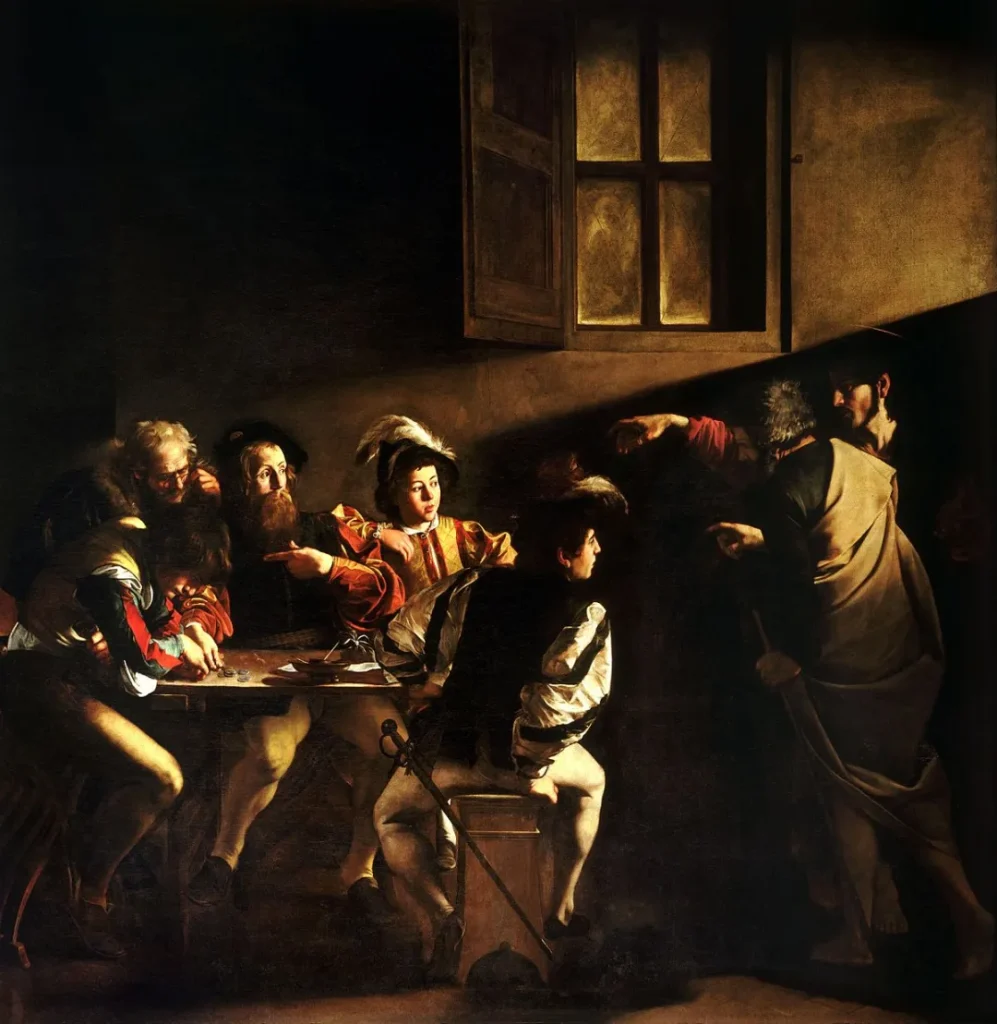
Caravaggio. The Calling of Saint Matthew, ca. 1599–1600.
In Caravaggio’s The Calling of Saint Matthew, a beam of light enters the room alongside Christ. It does not merely brighten the scene. It reveals reality. In that moment, Matthew sees not only Christ, but also himself—a vocation that had been present all along, hidden beneath the distractions of ordinary life.
It is a fitting image for this year’s ICLE National Conference theme, “Stepping into the Light.”
Throughout Scripture, light signifies far more than visibility. It is the presence of God, the revelation of truth, and the illumination of reality itself. Because of original sin, our intellects are darkened. We do not always recognize truth, beauty, and goodness as readily as we should. Through authentic Catholic education, however, that darkness begins to dissipate, and students grow in their ability to know, love, and serve our Lord.
How do we recognize authentic Catholic education? As C.S. Lewis observed, we must not merely study the light from the outside—we must step into it and see what it illuminates. We should judge education by what it reveals. Does it help students encounter reality more fully? Does it draw them into the great conversation of Christian civilization? Does it cultivate wisdom rather than merely accumulate information?
Too often, education is reduced to disconnected facts or the pursuit of whatever ideas happen to dominate the present moment. We possess, more readily than any generation before us, access to the greatest works ever written. The challenge is no longer whether these treasures exist, but whether educators will invite students to claim them as their inheritance. Unfortunately, Catholic schools are frequently constrained by secular academic standards that push the Catholic intellectual tradition to the margins—even in schools whose very mission is to pass that tradition on.
This tension gave rise to Classic Learning Test.
While serving as a college counselor at a Catholic high school, CLT founder Jeremy Tate noticed that students were avoiding philosophy and apologetics electives because those courses offered no AP credit. College admissions priorities had begun to shape curricular decisions, quietly displacing the very tradition Catholic schools existed to preserve. Rather than asking schools to compromise their mission in order to satisfy existing assessments, Jeremy asked a different question: What if we changed the standard?
From that question, CLT was born with a simple conviction: assessment should support a school’s mission, not compromise it.
That conviction points to a broader principle. Assessment is not merely an administrative necessity. Properly understood, it is an act of illumination.
Too often, assessments become little more than numbers to report, benchmarks to satisfy, or data points to compare. While these uses have their place, they can distract us from a more fundamental question: What is assessment for?
At its best, assessment serves the same role as light. It reveals reality.
A good assessment is not valuable simply because it produces numbers. It is valuable because it helps us see what is actually there. It helps teachers recognize what students understand and where they need support. It helps school leaders identify the strengths and weaknesses of their academic programs. It gives parents a clearer picture of their child’s progress. And it helps students themselves recognize both their accomplishments and the areas where growth is still needed.
This understanding of assessment is deeply Catholic. Truth is not something we create—it is something we discover. Likewise, assessment should help educators perceive reality more accurately so they can respond with both wisdom and charity.
The problem that gave rise to CLT—students being forced to choose between their intellectual inheritance and their academic credentials—is ultimately a problem of misaligned assessment. When the standards we use quietly redirect what our schools are for, they cease to illuminate and instead begin to obscure.
More than a decade after its founding, CLT continues to help Catholic schools align assessment with their moral, intellectual, and spiritual mission. By providing benchmarks rooted in the Catholic intellectual tradition, we seek to support educators in bringing souls from the shadows of ignorance into the light of truth. Assessment, rightly ordered, becomes another means of helping students encounter reality as it truly is—and ultimately, the Author of reality Himself.
The renewal of Catholic education requires many things: faithful teachers, beautiful schools, rich curricula, and vibrant communities. It also requires clarity. We need tools that illuminate reality rather than obscure it—tools that help educators see students more clearly as persons while keeping the work of forming them in wisdom and virtue always in view.
Must students continually choose between academic success and wisdom? Must schools choose between fidelity to their mission and preparing students for college? The answer should be no.
In Caravaggio’s painting, Christ’s light does not simply allow Matthew to see. It calls him to become who he was created to be. Catholic education serves that same purpose. Every lesson, every book, every conversation—and yes, every assessment—should help reveal reality more clearly so that our students, likewise, can become more fully who they were created to be.
John Paul Thurau is the Director of Catholic School Partnerships at the Classic Learning Test, where he works to advance the renewal of Catholic education through mission-aligned assessment. CLT exams are the only nationally normed grade-level assessments aligned with the philosophy of education found in ICLE schools. CLT evaluates reading, grammar, and mathematics in grades 3–12 through content rooted in the Catholic intellectual tradition, providing data that complements, rather than compromises, the mission of Catholic schools.