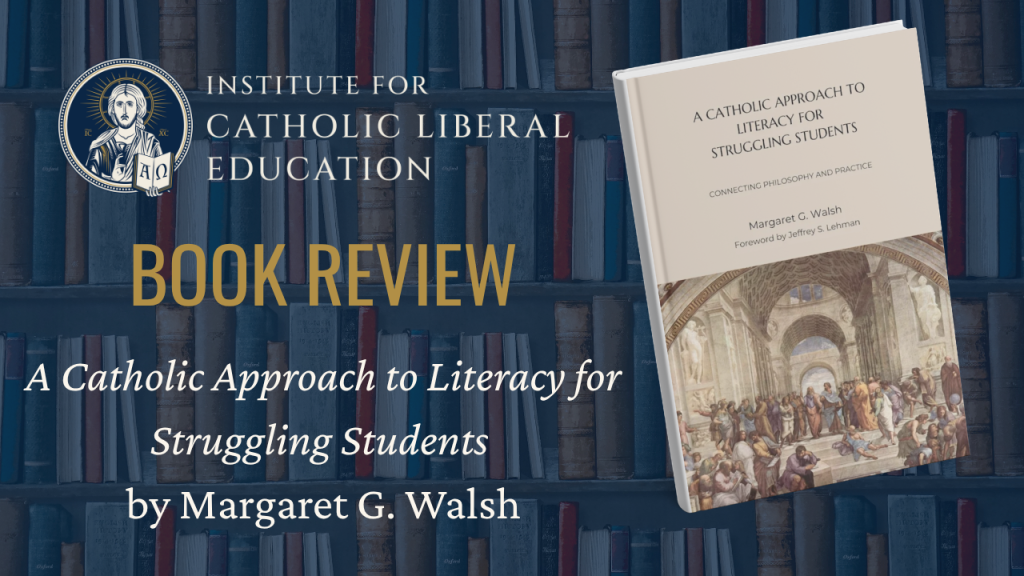
Margaret Walsh’s book, A Catholic Approach to Literacy for Struggling Students: Connecting Philosophy and Practice, offers educators not only a practical guide for literacy instruction, but shares how to best guide struggling students to become joyful readers.
“Man was created body and soul. This is the bedrock, so to speak, for the learning process.”
– Section 1. First Principles of Learning, page 3
In today’s landscape of education, a diagnosed learning disability runs the risk of becoming a student’s entire academic identity rather than a difference in learning that can be exercised. Instead of masking students behind a diagnosis, Walsh’s book rightly proposes that we ought to help our students to rise above their learning differences. She gives practical examples and resources (see the last half of the book for a treasure trove of resources at your fingertips!) for giving such help to students who may be struggling to read while grounding these practices in a Christian anthropology, that is, viewing the student as a whole person composed of both body and soul. This knowledge ensures that teachers can teach effectively through a shared understanding of who our students are and how they, and we, learn.
“When increasing students’ potential to learn, we are working with a body that, if exercised the right way, can grow in abilities.”
– Section 1. First Principles of Learning, page 24
The first portion of Walsh’s book begins with an explanation of how we, as human beings, come to know or learn, based on the rich teachings of some of the greatest minds history has shared with us: namely St. Thomas Aquinas, Aristotle, and Socrates, among others. Walsh walks her readers briefly through the learning process, how we as human beings come to conform our minds to the reality around us, and shares the main principles of learning before applying these principles specifically to literacy instruction. A glance at her table of contents shows the breadth and depth of knowledge this book has to offer! All learning begins in the senses, and so, Walsh begins with the topic of sensation. From there, she guides readers through perception, based on St. Thomas Aquinas’s writings on phantasms, followed by imagery and thought, that, “Man does not create his own truth, but must conform himself to the truth” – pg. 17. She rounds out this section with topics such as habit, association, and growth mindset, all of which play an important role not only in how a student learns, but in forming our students as learners.
“The art of learning is something that can be improved and evolve into a habit.”
– Section 1. First Principles of Learning, page 25
After setting her readers in a firm foundation of first principles and the philosophy of how humans learn, Walsh then uses the second section of her book to build on these principles and explore what she calls the “Essentials for Reading”, where she explains how students move from learning to read to reading to learn. While this portion of the book may be the most familiar for literacy teachers, Walsh’s firm foundation in Thomistic theology allows for a deeper understanding of the “essentials for reading”, such as the alphabetic principle, phonemic awareness, oral language acquisition, and other necessary aspects of literacy. As teachers read through this section, they will not only read about the basic foundations of literacy each student requires, but also learn about specific action items they can bring to the classroom to help students grow in these practices, as well as an understanding of why each practice is important and how it helps students to unlock the mystery of decoding and become fluent readers.
“ Without the proper development of language and hearing of spoken words, students will struggle significantly with language and reading acquisition.” – Section 2. Essentials for Reading, pg. 47
In her final written section, Walsh shares the most technical aspects of her book, offering, “the key to supporting your students in building phonemic awareness, alphabetic principle, and fluency”. Where some resources might be tempted to start with the practical, the philosophical background Walsh shared in the prior sections of her book allows readers not only to feel confident in implementing these teaching techniques, but also in understanding and explaining the founding principles behind them. This section, coupled with the appendices of resources, gives teachers literacy tools and techniques they can implement with students right away.
“Socrates doesn’t give the answer away but leads his students on a journey to discover the truth by way of question and answer, association and disassociation. Follow his lead and you will be able to guide your students in their journey, as well.”
-Section 3. Implementation, pg. 108
While Walsh’s book offers a wealth of information, it also shares formation. In a world where truth runs the risk of being seen as relative, this book stands to become just another person’s thoughts and advice on how to combat the problem of illiteracy. This is not so. Walsh’s book contains everlasting truths that all parents and educators would benefit from reading, learning, discussing, and practicing. She shares many practical tips and resources, to be sure, but what I think she offers most is a formation of the teacher, allowing her readers to continue to give the best to the students God has placed in their care.
As such, I would recommend this book to all educators and parents, Catholic or not, as the truths presented in this text are everlasting, but perhaps especially important for the educational environment we live in today. There is so much richness shared, and I hope teachers will take the time to read the book well and digest it so that the practices, tools, and philosophy shared benefit them and their students for years to come.
“If we are docile and conform our mind to the reality God has given us, we will start to see him through his creation, and this is our ultimate end.”
-Section 1. First Principles of Learning, pg. 4
If you are interested in learning more about teaching literacy in the tradition of the Catholic Liberal Arts, you may wish to join our next cohort of Catholic Educator Formation and Credential Program (CEFC) teachers, a groundbreaking alternative to state teacher licensure; a credential program that prepares educators to infuse a deeply Catholic philosophy and practice of education into their teaching.
A Catholic Approach to Literacy for Struggling Students: Connecting Philosophy and Practice.
By Margaret G. Walsh,
Catholic Education Press, Washington, D.C. © 2026
172 pages. Paperback. $29.95.
Available for purchase June 2026
The Author of this Book Review, Marie Kelly, is a Faculty Member of ICLE. Read More Here.
Published June 3, 2026