
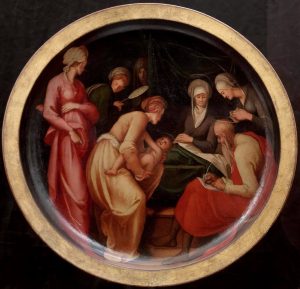
Nativity of Saint John the Baptist. Pontormo, ca. 1526.
It may seem odd to write about Christmas on June 24, which is the farthest day of the calendar year from the eve of Christ’s birth. And yet, the two dates have something in common as they represent the approximate dates of the two solstices. In the case of Christmas, we have the maximum amount of darkness, whereas in June we experience the maximum amount of light.
In his book The Spirit of the Liturgy, Joseph Cardinal Ratzinger demonstrates that the decisive factor involved in dating the birth of Christ was the connection to Creation, Cross, and Christ’s conception.
The whole story begins not with December 25, but rather with March 25. The African ecclesiastical author Tertullian (c. 150 – c. 207) discussed a well-known tradition that Christ suffered death on March 25, a day that was also associated with the creation of the world. March 25 was taken as the spring equinox (which we now know to be off by a few days), and hence the date after which light definitively conquers darkness. For the same reason, March 25 was also taken as the day of the New Creation (the Incarnation or Annunciation) as well as Christ’s Passion. In each of these events, there is an element of light overcoming darkness.
St. Thomas Aquinas, quoting a fifth century source, reiterates the dates of both March 25 and December 25, as well as their cosmic significance. It is here that we find reference to today’s great solemnity: The Birth of John the Baptist. Aquinas points to Scripture’s placing of the Annunciation in the sixth month of John the Baptist’s conception. He understands the “sixth month” to be March, with the day being the 25th. Like Tertullian, he then places Christmas nine months later, on the 25th day of December. This puts the conception of John the Baptist on the autumnal equinox, the Annunciation on the vernal equinox, and the Nativity of Jesus on the winter solstice. On the vernal equinox, the light overtakes the darkness, a cosmic event that reflects the Incarnation. On the winter solstice, we encounter the height of darkness and the moment when light turns from a period of decrease to a period of increase. This too is fully appropriate for the birth of the one Who lightens the world and all of humanity.
St. Jerome also comes out in support of these ideas: “Even creation approves of our preaching. The universe itself bears witness to the truth of our words. Up to this day [December 25, the approximate date of the winter solstice] the dark days increase, but from this day the darkness decreases … The light advances, while the night retreats.”
With the two equinoxes and the winter solstice now having historical and cosmic significance, that leaves only one of the four major solar dates: the summer solstice. If the conception of John the Baptist is on the autumnal equinox (September), then his birth, nine months later, falls on the June solstice, precisely when the amount of daylight starts to decrease. “The link between the dates can now be seen as a liturgical and cosmic expression of the Baptist’s words: ‘He [Christ] must increase, but I must decrease’ (Jn 3:30). The birthday of St. John the Baptist takes place on the date when the days begin to shorten, just as the birthday of Christ takes place when they begin to lengthen.”
On this great solemnity, let us spend our daylight hours, maximal as they are, abandoning ourselves in both awe and wonder to Jesus Christ, and praying with the Forerunner, “May I decrease so that He may increase.”