
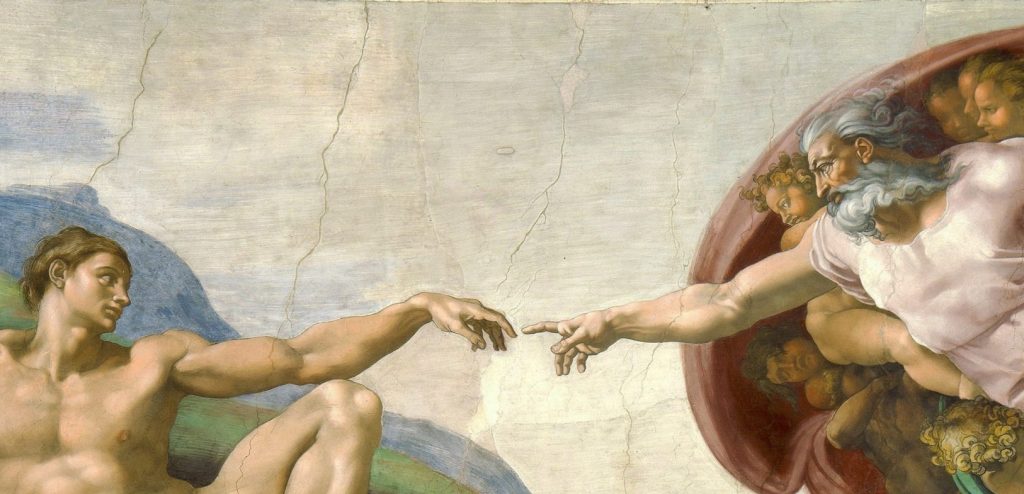
The Creation of Adam. Michelangelo, ca. 1512.

Pope Leo XIV’s highly anticipated new encyclical has been billed as a manifesto on artificial intelligence. Without taking anything away from the obvious—the phrase “artificial intelligence” is indeed contained within the subtitle of the document—this is a document firstly about the nature of what it means to be human.
The title is, after all, Magnifica Humanitas, or “Magnificent Humanity.”* The document appropriately begins and ends with this conviction, and the Holy Father’s closing entrustment to the Blessed Mother captures it well: “that she may guide our steps through this time of change and preserve in each of us true faith in the Gospel, so that we may bear witness to the grandeur of humanity, in which God has made his dwelling.”
Again, this is to take nothing away from the fact that Pope Leo makes profound statements about artificial intelligence, both in its nature and in its applications, many of which can and should be unpacked by the Church over the next several years. I only mean to say that the Holy Father clearly wants to ground the conversation with an authentic view of the human person—what John Paul II once famously described as “an adequate anthropology.”
For example, Pope Leo reminds us that A.I. merely imitates “certain functions of human intelligence.” It does not undergo experiences, possess a body, feel joy or pain, or mature through relationships. Nor does it even “know from within what love, work, friendship or responsibility mean.” It does not have a moral conscience, and perhaps most importantly, lacks the “relational and spiritual perspective through which human beings grow in wisdom”. This distinction matters precisely because the large language models have become quite adept in their imitation of human language, which poses a particular risk for us as we continue to engage with them. “The danger is not so much that a person may believe they are communicating with another person, but rather that they may gradually lose the very desire to form genuine human connections.”
All of this is relevant to us teachers, because the very task of educating students is founded on an understanding of the human person. Because of this, it is unsurprising that Leo dedicates ample space to discussing this topic. After all, “school is the place where new generations can learn to seek and love the truth, to reflect on the meaning of life and to recognize the dignity of every person.” Such a succinct definition of the purpose of education presents a jarring difference from a view that sees the process as far more pragmatic. For example, if the human person is merely an economic agent, then school should be about career preparation, and discernment about the use of artificial intelligence in the classroom will be guided by the details of that preparation.
However, if the human person is an eternal soul made in the image and likeness of God and imbued with a love for truth, then school should be about the formation of these precious souls, and engagement with artificial intelligence must be discerned in light of that formation. These are two entirely different visions of both the human person and therefore the nature of education, and the consequences of one over the other cannot be overstated. “Without careful attention, an educational system lacking in a love for truth may emerge, in which an incessant flow of information replaces the essential exercise of research, reflection and discernment. As knowledge becomes increasingly fragmented, it becomes difficult to grasp reality as a whole, to ask profound questions about meaning, or to develop authentic, critical and creative thought.”
Perhaps the most important statement in this section is a beautiful portrait of how education ought to proceed:
Education is a long journey requiring patience, and therefore needs time for development and for engagement with reality beyond appearances.… As Plato wrote, the deepest and most important things are learned only after much time and effort, by engaging in discussion with others, ‘striking upon’ ideas and experiences together like flint until the spark of understanding is kindled within us.
One could hardly ask for a better defense of the content and pedagogy contained within the Catholic liberal arts tradition—the patient reading of great texts, the art of inquiry that refuses easy answers, or the slow formation of judgment through an encounter with beauty, goodness, and truth.
This bold vision stands in contrast with the short-sighted, standards-based, mastery-driven view. To be clear, there certainly are skills and facts that are important in every class, things that we want students to know and to be able to do. But these are not nearly as important as the things we want students to encounter and to love. A student might learn the structure of Aquinas’s arguments for the existence of God—but this is different from the startling realization that the world need not exist at all, that everything depends on a Being who simply is, and that this opens into genuine wonder about God Himself.
A student might memorize and apply the Pythagorean theorem—but this is different from encountering the sheer elegance of mathematical order. A student might learn the plot and themes of the Odyssey—but this is different from being arrested by Odysseus weeping on the shore of Calypso’s island, longing for home, and feeling the weight of that longing in one’s own life. All of this requires “time for development and for engagement with reality beyond appearances,” and the very nature of A.I. is to circumvent it. “The speed and ease with which answers or summaries can be obtained risk extinguishing the desire to ask questions, which is a process that bears fruit only over time.”
As we teachers continue to wrestle with educating our students in this world of “new things” (rerum novarum), let us keep our attention on a vision that is more than, for example, educating students as mere economic agents. Rather, let us help our students encounter those “deepest and most important things” that make up “reality beyond appearances” in order to cultivate both faith and reason for full human flourishing. And with Leo, let us look to Jesus Christ for our model, knowing that it is “only in the mystery of the Word made flesh that the mystery of humanity truly becomes clear.”
That quote, which is the encyclical’s first magisterial reference, comes from Gaudium et Spes. The particular paragraph (GS 22) ends with one of the most important anthropological statements in the Church’s recent history, and one of Pope John Paul II’s favorites: “Christ, the final Adam, by the revelation of the mystery of the Father and His love, fully reveals man to man himself and makes his supreme calling clear.” I can think of no better words to ground us when thinking about A.I., which will always be artificial, and in the ways that matter most, never truly intelligent.
* The Vatican has not released the official Latin text yet, but the phrase “magnificent humanity” appears at the start of the first sentence in the Italian (magnifica umanità), French (magnifique humanité), and Spanish (magnífica humanidad) versions. The English version is the only one that seems different, containing instead “Humanity … in all its grandeur.”
J. Jake Tawney is the Director of Curriculum and Academic Resources at the Institute for Catholic Liberal Education. Read More.
| Published June 2, 2026. |