
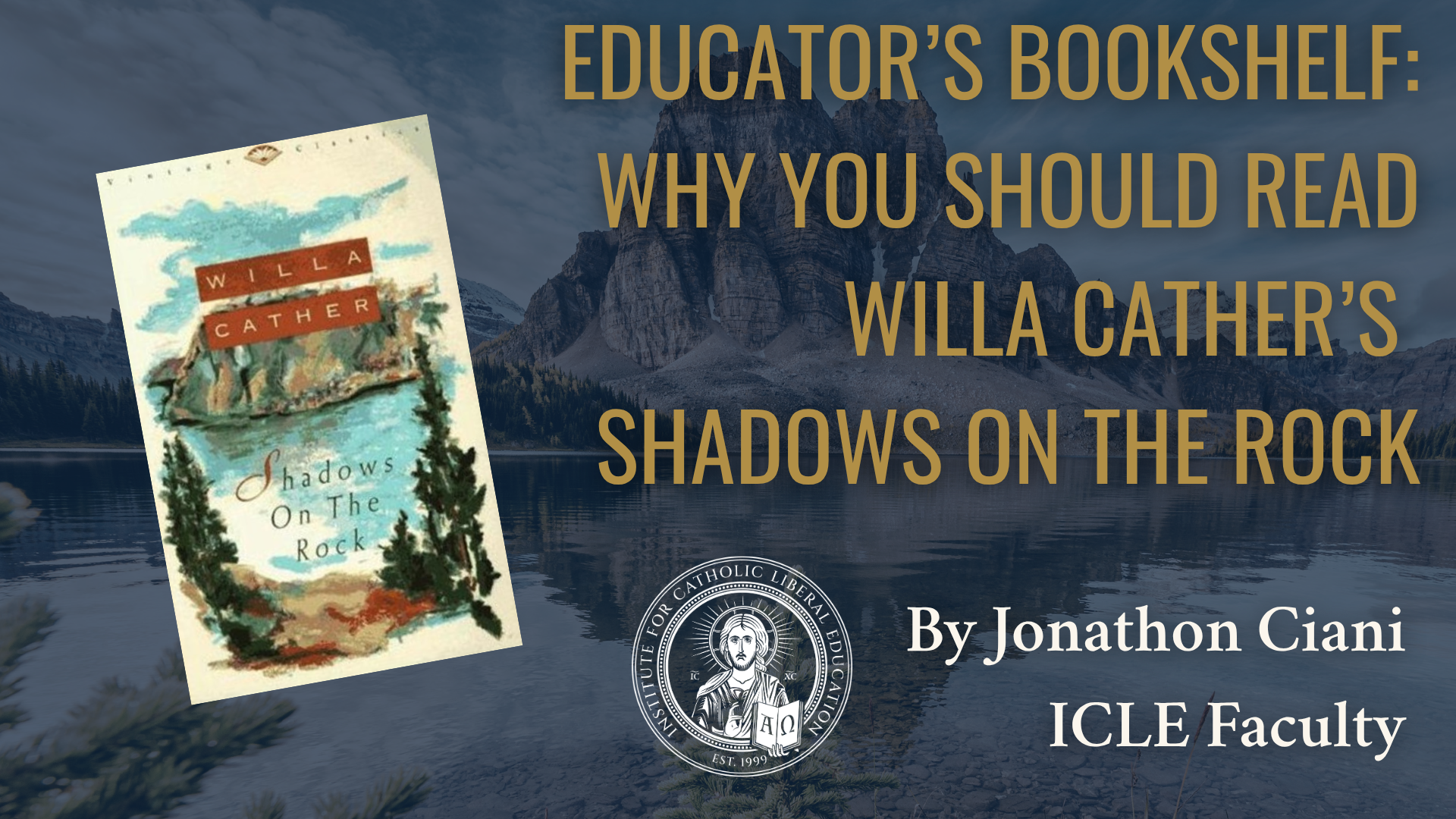
Knowing full well that there are many good books to read and that you’ve already got your own list, we risk a recommendation: Shadows on the Rock by Willa Cather.
Miss Cather, fresh off writing about the travails of missionaries in New Mexico, turned her attention to the seventeenth century colony of Quebec. While the historical St. Francois Laval appears throughout, the heart of the story belongs to Euclide Auclair, an imagined apothecary and his young daughter, Cécile — the main characters through whom the reader experiences life in this strange, wild country.
The story opens with the departing of the French fleet and a colony left in complete isolation from civilization. There are acts of astonishing piety, daring adventures through the snow, and simple, exquisitely rendered domestic scenes. These different episodes are united by the common cause of the pioneers who are charged with building up a new home for themselves while preserving the inheritance of their past.
The most important inheritance these pioneers carry into the new world is their Catholic faith. The Faith must be preserved, but also translated into this new environment, and Cather, though not a Catholic herself, exercises her undoubtedly sacramental imagination as she describes the town in a sacramental register, “the rock of Kebec stood gleaming above the river like an altar with many candles, or like a holy city in an old legend, shriven, sinless, washed in gold.” And when Cécile hesitates to include a young boy’s rustic carved beaver in her majestic crèche brought from France, she is told, “put it there with the lambs, before the manger. Our Lord died for Canada as well as for the world over there.”
A passing moment like this would be dismissed by a writer who lacked Cather’s sacramental understanding of life as an arena “where the great matters are often as worthless as astronomical distances and the trifles dear as the heart’s blood.”