
April 23, 2026 — The 2026 National Catholic Educational Association (NCEA) Convention took place in Minneapolis, MN April 7-9 and opened with a bustle of almost 4,000 Catholic educators, leaders, and vendors. Amidst all the hubbub, I was most deeply struck by Bishop Andrew Cozzen’s opening keynote, one of the most compelling addresses I have heard.
The talk, entitled “The Heart’s Need for Beauty: In Defense of a Catholic Education,” began with a stark look at the condition of our popular culture. Bishop Cozzens showed a video of pop singer Gracie Abrams singing her hit song “Camden.” Lyrics include “All of me a wound to close, but I leave the whole thing open. I just want to let you know, I was never good at coping.” The contrast was striking: a beautiful woman in the full bloom of life, with every gift and resource imaginable, singing of the emptiness and desolation that she feels, while she leads thousands of fans to sing along. Whether or not the words are personal for Abrams, the popularity of the song certainly demonstrates that she has tapped into the spirit of our times. As Cozzens concluded, “Brother(s), sisters, this is the height of popular culture. This is what our young people are singing about, the gaping wounds in their hearts.”
Bishop Cozzens’ heart-wrenching illustration of the deep alienation in the lives of young people today is timely, as rates of depression, anxiety, and suicide steadily rise amongst the young. Despite our incredible material advantage and relative security, we are lonely and alienated.
As Bishop Cozzens proceeded to point out, this is a problem of the heart. Advances in AI cannot solve this deep human crisis. Politics cannot address the void in our secular lives. “In fact, it seems to be making it worse,” he said. In the face of an era of loneliness, the importance of Catholic education is made evident. He reminded the audience that the Church is expert in humanity because we have Christ. The Incarnation of Christ reveals what humanity is, what its purpose is, and how happiness, even in the face of suffering, is made possible. In other words, Christ offers us a true anthropology from which we can discover the workings of our own selves. The Church knows where we can seek the happiness that seems so rare in these times of materialistic desolation. The Church knows what our hearts long for. This, of course, is what Catholic liberal arts education is all about.
Bishop Cozzens referenced the Catechism’s beautiful account of the heart, which reads: “The heart is the dwelling-place where I am, where I live… the heart is our hidden center, beyond the grasp of our reason and of others; only the Spirit of God can fathom the human heart and know it fully. The heart is the place of decision, deeper than our psychic drives. It is the place of truth, where we choose life or death. It is the place of encounter, because as image of God we live in relation: it is the place of covenant.” (CCC 2563)
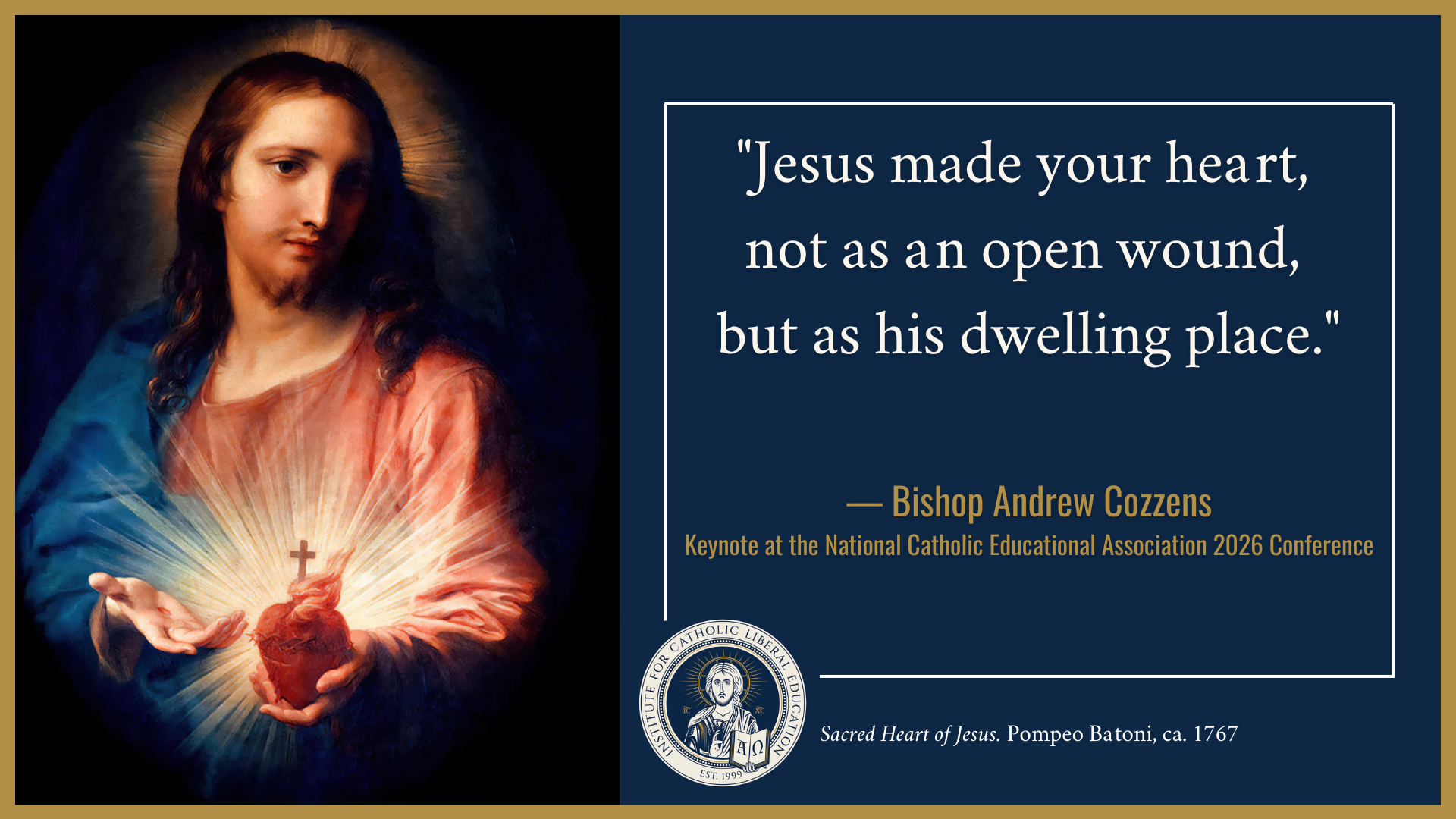
On the one hand, as St. John Paul II states in Redemptor Hominis, “…man cannot live without love.” On the other hand, human nature cannot save itself. Our hearts cannot be satisfied by anything less than Christ Himself. Bishop Cozzens reflected, “Jesus made your heart, not as an open wound but as his dwelling place.” So how does a healing of the human heart occur, and what is the role of the Catholic teacher in this process? Bishop Cozzens offered a practical three-step process to help teachers guide their students.
First: “We must help our young people understand their hearts are broken.” The Church offers an answer to the human problem, and a fundamental aspect to this is the recognition of good and of evil, not only in the world but within myself. Students must be brought face to face with the drama of the battle between good and evil and take personal responsibility for this dynamic in their own lives. On a most practical note, “take them to confession!” Bishop Cozzens instructed.
Second: “We must help them have their hearts healed by love.” This healing of the heart occurs through an experience of being loved, despite all brokenness. This healing cannot merely be a static lesson that students come to know abstractly. It must be known through experience. “Healing of the human heart has to happen by experience, and it happens primarily through the experience of being loved,” Bishop Cozzens said. “We call it mercy: unearned love. It restores. It regenerates. It reveals the truth about ourselves. This is the love that our young people are longing for, that you and I are longing for, and that God is longing to give.”
Finally, young people “…must learn that they will only find happiness in making a gift of themselves.” Here Bishop Cozzens directed the audience to St. John Paul II’s Law of the Gift, citing Theology of the Body: The human person cannot truly find himself unless he makes of himself a true gift.
Bishop Cozzens also offered the audience a personal challenge. “Would it be too much to ask Catholic educators to make a commitment to daily prayer?” He asked this question with force. We cannot give what we ourselves do not possess. As teachers, we too are broken-hearted. We cannot save ourselves, we must be healed by Christ’s love and, ultimately, make a gift of ourselves. In this sense, the vocation to teach is a calling to sanctity.
Bishop Cozzens’ words and the absolute sincerity with which he spoke were inspiring. His evident love and leadership were a true blessing for the thousands of Catholic educators gathered together in Minneapolis. We are lucky indeed to have such a shepherd!
His words echo the ICLE work and mission. Healing the modern, alienated heart requires a Catholic education centered on true anthropology and the Incarnation. The need for beauty and the “Law of the Gift” aligns with our mission to form the whole person in truth, goodness, and beauty through the Church’s intellectual tradition.
 Editor’s Note: In addition to attending the keynote, Peter Crawford, Academic Dean of the Institute for Catholic Liberal Education, represented the ICLE as a featured speaker at NCEA 2026. On April 7, he delivered a talk entitled, “Our Hearts Are Ready: Turning to the Path of Wonder.” His session addressed the fragmentation and loneliness of our times by proposing a return to wonder in the classroom. Peter shared that his “hope is to recenter our sense of the purpose of Catholic education, to share reflections on the tradition of Catholic education that have sometimes been disregarded, and to plant seeds in the hearts of educators who likely represent the broad swathe of Catholic education on a national basis.”