 The Institute for Catholic Liberal Education (ICLE) is blessed to officially introduce Monsignor John Cihak, S.T.D. as ICLE Chaplain, a role he has faithfully held since July 2025. He also serves as a member of our Board of Directors. In his beloved hymn “Lead, Kindly Light,'” St. John Henry Newman petitions for guidance “amid the encircling gloom” from Christ, the “Kindly Light.” We look to our new chaplain as someone for whom that Light has been a great navigator. A priest of the Archdiocese of Portland, Oregon, Msgr. Cihak is a scholar-pastor who brings to our mission a profound depth of experience, from serving as a Papal Master of Ceremonies for both Pope Benedict XVI and Pope Francis, to his current role as pastor of Christ the King Parish.
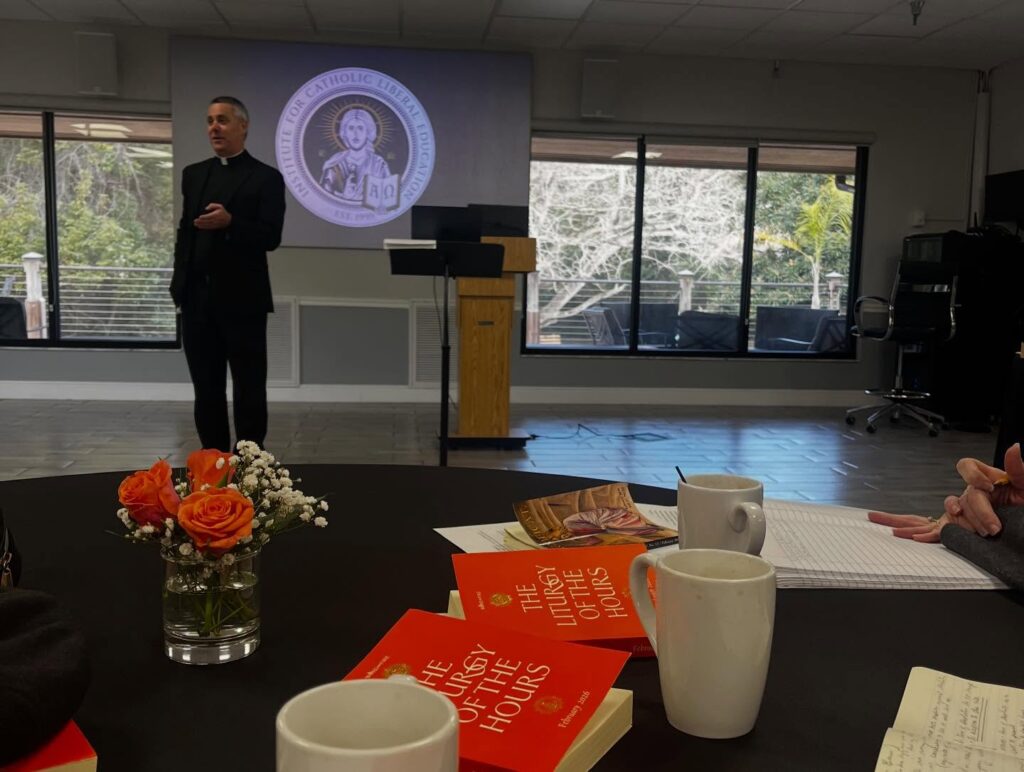
This week, our entire ICLE team is on a retreat at the San Pedro Spiritual Development Center in Winter Park, Florida. Msgr. Cihak is serving as our retreat master, guiding us in prayer and reflection. As an introduction, we engaged with Monsignor to discuss his background, his theological work, and his perspective on the future of Catholic education.
Q&A WITH OUR CHAPLAIN
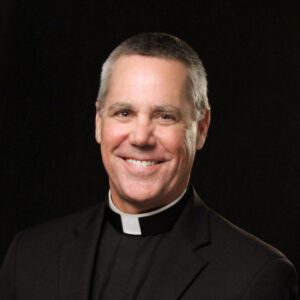
Msgr. John Cihak
You moved from studying philosophy at the University of Notre Dame to earning a Licentiate in Fundamental Theology and a Doctorate in Dogmatic Theology from the Pontifical Gregorian University in Rome. How did this progression shape your view of the relationship between faith and reason?
My introduction to this world happened when I switched from pre-med to philosophy as my vocation began to take form. At Notre Dame, I immediately noticed that my professors had us reading primary texts rather than secondary sources. We were expected to wrestle with the author directly. This classical approach continued when I became an adjunct professor at the Pontifical Gregorian University. In my seminars on Trinitarian and Fundamental theology, we engaged the sources directly, which taught me that reason, when applied to the great texts, provides a common language that leads us more deeply into the mysteries of the Faith.
- You served as a theological consultant for the Spirit of Truth K-12 Catholic faith curriculum. How do you see the integration of high-quality catechesis working in harmony with the broader liberal arts curriculum?
While I was at the Vatican, I assisted with the doctrinal reviews for Spirit of Truth. My role was ensuring that everything was expressed accurately and conformed to Catholic doctrine. In a liberal arts setting, Catechesis isn’t just a subject—it is the lens through which we view reality. When our doctrinal language is precise and beautiful, it integrates seamlessly with the pursuit of truth in all other disciplines.
- You served as a Papal Master of Ceremonies for two Popes. What did that unique vantage point teach you about the universality of the Church and the importance of sacred liturgy?
Serving Pope Benedict XVI and Pope Francis gave me a full taste of the Church’s universality. Whether we were in Rome or traveling abroad, I noticed that where there was a foundation in Catholic liberal education, there was a striking commonality of thought. Even when we spoke different languages, that shared intellectual and liturgical heritage gave us a common approach to reality. It showed me that the liberal arts are a unifying force for the global Church.
- Your book, Balthasar and Anxiety, explores the redemption of human struggle. How might a Catholic liberal education provide a sense of “ordered peace” in an era of high anxiety?
My doctoral work on Hans Urs von Balthasar dealt with how anxiety—so prevalent today—is redeemed by Christ. A Catholic liberal education is the cure for many of our societal ills because it provides a point of reference to reality. In a culture oversaturated by media and shallow discourse, returning to the Great Books helps students find an ordered peace by grounding them in what is true, rather than in the shifting anxieties of the moment.
- What drew you to the work of the ICLE, and what do you hope to contribute as our National Chaplain?
I have seen the fruits of ICLE’s mission firsthand. As a pastor, I see it as the pathway forward for forming teachers and renewing schools. As ICLE Chaplain, I want to help the staff deepen their own relationship with Christ. We cannot be a great apostolate if we are not first a cohesive team in the Lord’s hands.
- As pastor of Christ the King in Portland, you see the daily reality of parish life. How does being in the trenches of a parish and school inform your leadership on the ICLE Board?
Being in the trenches allows me to see the impact of this renewal on real families. I am particularly drawn to the role of the priest’s spiritual fatherhood in the school. We won’t have a true renewal without pastors leading the charge, and I love helping my brother priests reclaim that role and lead their schools back to their Catholic roots.
- As our retreat master this February at the San Pedro Spiritual Development Center, what is one hope or prayer you have for the ICLE team as we gather in reflection?
My primary prayer for the ICLE team is that this time away at the retreat center serves as a true re-centering on the person of Jesus Christ. We often talk about the mechanics of school renewal, but we must remember that we cannot give what we do not have. I hope that through our reflections, each member of the team can experience a deepening of their own spiritual life and a reclamation of their unique role in the Church’s mission — whether that is through spiritual fatherhood, motherhood, or as a witness to the truth.
- What is a favorite hobby that helps you recharge?
I am a musician; I love both listening to and playing music. My tastes are very diverse — everything from Gregorian chant to hard rock. I also enjoy hiking and spending time with my family; I currently have 26 nieces and nephews (and five grand-nieces and nephews so far).
- Who are models of faith for you (Saints, role models, etc.)?
Personality-wise, I have a great affinity for St. Francis de Sales. I also hold devotions to St. John Vianney, St. John the Apostle, and St. Therese of Lisieux. I had the privilege of meeting St. Teresa of Calcutta a few times, and I met St. John Paul II several times. One of the highlights of my life was serving as a deacon in his private chapel; during the elevation, our elbows were touching. To be that close to the Successor of Peter, who was a living saint, was a moment of profound grace.
As Msgr. Cihak leads our team this first week in February, his guidance reflects the heart of St. John Henry Newman’s famous hymn, “Lead, Kindly Light.” In an era where education can feel overshadowed by “encircling gloom” distracting children from full human flourishing, we do not ask to see the distant scene; for our mission, “one step enough,” is to re-center ourselves on the person of Jesus Christ.
We invite you to join the ICLE staff in prayer for our mission and and for Msgr. Cihak as he leads us in reflection. May this time of spiritual renewal help each member of the team experience a deepening of his or her own spiritual life, trusting that the “Kindly Light” will lead us forward as effective instruments in the Lord’s hands.