

“Boy Writing With His Sister” Albrecht Anker 1875 wikiart.
Let’s begin our question of assessment with the question of work; after all, what do we teachers assess but the work of our students?
A STUDENT’S WORK
The Catechism states that work is “the collaboration of man and woman with God in perfecting the visible creation” (Catechism of the Catholic Church, 378). And this visible creation includes our own selves as much as it includes the world external to us. As John Paul II says in his Letter to Artists, “God therefore called man into existence, committing to him the craftsman’s task. Through his ‘artistic creativity’ man appears more than ever ‘in the image of God’, and he accomplishes this task above all in shaping the wondrous ‘material’ of his own humanity and then exercising creative dominion over the universe which surrounds him” (Letter to Artists, 1). Our vocation to work is a way in which we image God. And yet, as the pope says here, the most noble work we have to do is the work of shaping our humanity. This,then, is the work of the school: to come alongside the student as he grows in human vocation or perfecting the world around him and in growing in his own humanity. This is why the Pope also reminds us that “however true it may be that man is destined for work and called to it, in the first place work is ‘for man’ and not man ‘for work’ (Laborem Exercens, 6).
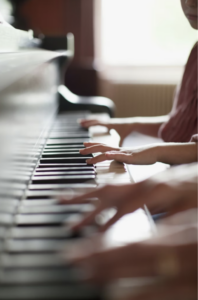
public domain (unsplash.com)
A student’s work, then, takes its shape from the shape of the human person. What might this look like? A student’s work should be embodied: work that is enfleshed in their person, whether it be through beautiful penmanship, acting, memorizing and reciting, classroom chores, or handwork. A student’s work should also express deep understanding rooted in knowledge. And a student’s work should lead to an urgent desire for better ways to solve the burning and noble questions that arise from their encounter with reality.
If work is for man, then, even before we discuss assessment, we must ask, “Is the work we ask of our students worthy of them?” Does it ennoble their humanity? Does it engage their faculties of intellect and memory deeply? Does the body have a useful and important role in student work? Does the work open up new vistas of sight to the student? Or is it clutter and kitsch, destined for the waste basket? Is it work that exists because it’s easy to grade or simply because a grade is needed?
ASSESSMENT
With all this in mind, let’s consider assessments . “Assessment” comes from the Latin word, “assessus,” “to sit beside”. In assessment, the teacher “sits beside” the student’s progress in his or her work. When we assess a student’s work, we sit beside the student in order to gauge his or her progress in work. Assessments gauge knowledge and understanding, but also the skills that are required for deeper knowledge and understanding.
Now, a worthy assessment teaches as much as it assesses. What and how we assess reveals what we consider important. Good questions to ask yourself are: “Does this assessment assess what is most important? What am I communicating to my students about what is important about my class?” The assessment should avoid arbitrariness and should flow naturally from the work the students already do in class.
Assessments also cultivate habits. In forming habits, we often think we should start with the internal, the disposition. But the tradition and current psychology teach us that action is first. Thus, if we want to form the habit of attention to detail, we must begin acting with attention. Repeated and frequent actions of attention to detail will after time result in the habit of attention, which in turn leads to a stable disposition of attentiveness. Assessments, insofar as they require repeated actions from the student, have the ability to form in that student intellectual, moral, and physical habits, which lead, ultimately, to the formation of their disposition.
Lastly, assessments assess the teacher. If an assessment doesn’t go well, it is a mark of humility to pause and reassess how we taught or how we designed the assessment. Sometimes, the cause of students’ poor performance can be obscure. Did the students not study enough? Did they not understand? Were the questions worded confusingly? Did I not teach it well? Pausing to consider the nature of the trouble will aid the teacher more quickly to understand the nature of the problem in order to better offer a remedy.
Ultimately, a good assessment is one of the ways in which a teacher “sits beside” her student to accompany the student as he or she does the good and noble work of the thinking human person. Here are a few practical considerations for assessments:
- Always include clear and thorough instructions.
- Understand the psychology of test-taking.
- Give specific parameters for open-ended responses.
- Let students know how they will be graded before they begin working on an assignment.
- Consider using a post-assessment reflection to encourage the habit of self-reflection.
PLANNING ASSESSMENTS
Your course is a work of art. A beautiful class has an overarching vision. It has central questions and central themes. It is shaped with a beginning, middle, climax, and end. There is a rhythm to a beautiful course, and a rhythm to assessments. Consider, too, that repetition is the mother of learning. Habits are developed through repetition and careful attention to how the student is cultivating them. They are also learned gradually, and for this reason calibrating assessment difficulty can be a great tool. Assessments should deepen and develop over the course of the year. As you plan the work of art that is your class, here are a series of questions to consider:
- What is the reality the student is attending to in this unit and what skills does the student need in order to attend and see that reality more deeply?
- How will you teach those skills using a gradual progression of mastery?
- What type(s) of assessment are natural to this topic and work?
- What is a good rhythm of assessment? Consider assessing often enough that you are able to gauge student progress, but not so often that it distracts from the nature of the work.
CONCLUSION
Assessments are, at their heart, a way in which we love the students. We love our students by calling them more deeply into reality. We love them by accompanying them through the struggle and challenges of growth. We love them by loving to grow and deepen ourselves. Ultimately, a good assessment is an act of hope: it manifests loving confidence that we are called to go “further up and further in” into the goodness of creation and that each of us have been given beautiful capacities to do so.