
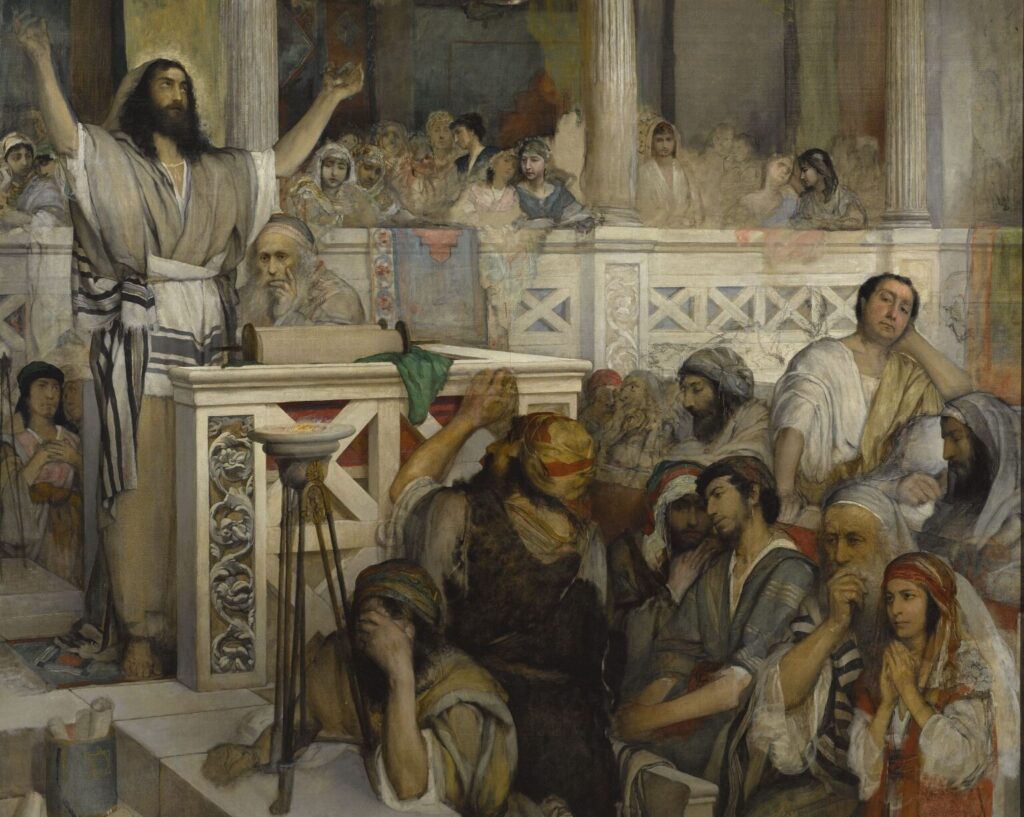
Christ Teaching at Capernaum. Maurycy Gottlieb, ca. 1878–79.
This time of year I love listening to the Little House on the Prairie series. There is something endearing about the repeated references to hard work, delicious food made from scratch and rich encounters with living off the land. While the Wilder family received little formal schooling (in the modern context), those kids sure were smart, with no shortage of ways to apply their learned knowledge.

Rosa Bonheur, Ploughing in the Nivernais, ca. 1849.
The books describe such an honest and true way of living. To think that the test of Almanzo’s character as a 9 year-old boy is if he can successfully raise oxen or sow seed in a field, all by himself. For their family, survival hung in the balance every year and yet they lived full lives immersed in true experiences with reality. This way of living resulted in heroic virtues like courage, temperance, resolve, patience and gratitude at a very young age.
One did not need to track or fabricate the encounters with learning because it was literally front and center. There was no option to escape or to amuse and entertain oneself to death. You had to be constantly forecasting, planning, and preparing for what was around the corner. For generations, reality served as the lesson and nature as the classroom.
But slowly, over time, things began to change more and more. The notion of a ‘way of living’ morphed into ‘what do you do for a living’ as things got in the way. With promises of efficiency and a ‘better way’ of living, there began more ‘doing’. Adults moved away from modeling and teaching and into systems and structures. These society norms affected culture and bled into classrooms. Leadership began looking to ‘standardize’ learning and make it fair and safe for all to learn. Well-intentioned, one cannot help but notice that we seem to be running from something.
Today’s world offers a glimpse of reality. K-12 students are afforded the chance as young people to tap, scroll, and swipe all the while preventing a single callus from gracing their palms. Advertisements offering free 5G streaming in every room of the house entice everyone to stay nestled inside their individual rooms and avoid even something as commonplace as family dinner. They are offered a chance to navigate ‘virtual reality’ before they even scratch the surface at coming to know what is real or not.
Schools have not been immune to this perceived new “encounter with reality.” We find ourselves in the midst of a highly measured, regulated and policy-laden educational system. Standardized test scores, benchmarks, data points and strategic plans govern much of the decision making process. Accreditation, licensure, certification, and documentation seem to govern the educational landscape.
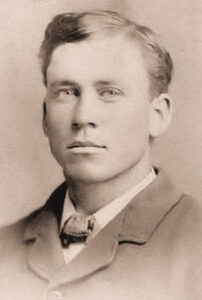
Almanzo James Wilder,
February 13, 1859.
And yet, somewhere off in the distance, I can hear 9 year old Almanzo saying, “What are you all afraid of?”
Administrators are not unaffected by this shift. For the longest time, schools were governed by virtuous human leaders in pursuit of the truth for their students. In the midst of formally assessing everything, administrators seem to have forgotten an aspect of their calling. Some are afraid of failure or being fired, others afraid of being wrong, and still others are afraid of being free from all of these measurements holding them down. Some are afraid of lawsuits and headlines and others are afraid of the parents of their students.
Fear grips man like an unwelcomed anchor preventing him from pursuing or speaking the truth. Oftentimes, having the courage to say and live the truth unteathers and frees man.
I’m not talking about righteous indignation. I’m talking about school administrators and Educators boldly proclaiming the truth evidenced in the gospel and found in behaviors and practices happening within the culture of the school community. Yes, we are called to boldly proclaim the truth to this audience because this vocation is about formation. Much like the Wilder’s life, it is very human and very hard, but takes place over a long period of time and is immensely fulfilling.
We must constantly remind ourselves of this calling described by The Congregation for Catholic Education 2022, who states it pretty clearly, “The mission of The Church is to evangelize, for the interior transformation and the renewal of humanity. For young people, school is one of the ways for this evangelization to take place.”

Rosa Bonheur, Ploughing in the Nivernais, ca. 1849.
Evangelization is about saving souls. For this transformation that CCE is speaking about, it needs to be internalized in the heart of individual Catholic School leaders. This will take courage to be honest and live a virtuous life drawing others into the heart of Christ.
And yes, there will be obstacles in the way. Too often school administrators are tugged and pulled by regulations written by some very far removed from schools and then left to enforce these policies and manage people’s emotions in the aftermath of rules that do not always support the human person.
There are also managerial philosophies that prevent the truth from being lived. The old adage of administrative work is “don’t change anything the first year. You will need to understand the people and the culture first before making any big moves.” An alternative consideration was recently described to me at the ‘scorched earth method’ often found in company mergers or when new governments are elected or when coaching staffs take over at the helm. That argument is predicated on ‘why would you prolong the inevitable?’ or put slightly differently: ‘Why not just rip the bandaid off all at once?’ Well, perhaps a better question is what is the virtuous thing to do?
But educational administrators are a unique breed and do not need fit into these stereotypical philosophies. Their life’s work is spent daily on forming the hearts and the minds of their community. Meanwhile, the modern cultural climate takes great lengths to preserve an equality between knowledge and truth. Instead of saying a truthful thing, oftentimes messages are masked in ways to avoid offense or conflict. This is the ripe opportunity for leaders to speak clearly into moments of great consequence and because the truth has a way of allowing us an encounter with the Savior.
I harken again on the words of Pope Benedict XVI during his Apostolic Journey to the United States on April 17, 2008, at The Catholic University of America in Washington, D.C.:
“Far from being just a communication of factual data – “informative” – the loving truth of the Gospel is creative and life-changing – “performative” (cf. “Spe Salvi,” 2). With confidence, Christian educators can liberate the young from the limits of positivism and awaken receptivity to the truth, to God and his goodness. In this way you will also help to form their conscience which, enriched by faith, opens a sure path to inner peace and to respect for others.”
What is unique to education is that we are talking about the formation of the human person. Christian Anthropology matters and proclaims that the person is not a metric, not an output. Nor a transaction or measurement of proficiency.
Those working in Liberal Arts schools should acknowledge this with even greater clarity. As Kevin Clark and Ravi Jain describe in their text The Liberal Arts Tradition, “The whole vision for education in the classical tradition can be summarized in the proposition that education is directed at perfecting inherent human abilities. Education trains and directs these things. (p. 23)” With this directed attention, students will need to be told the truth in a myriad of ways. Some may need to be told that despite their resolve, they will not become an NBA legend, or that while it seems like small white lies right now, fostering the habit of lying will catch up to them, and others that they are wasting their abilities. These are realities but they are true for many students.
The more time one spends around a particular thing he moves from knowledge to understanding and eventually to wisdom. Truth works this way as well. The more you embrace the truth of the matter, the richer and deeper you come to know. It requires detachment, openness and humility.
So what is the solution? I encourage you to read Pope Benedict XVI’s full address to educators in 2008 at the Catholic University of America.This serves as the primary remedy for educators to understand their role seeking the truth. Within this address he covers what he calls the “crisis of truth” and offers a solution for teachers:
“How might Christian educators respond? These harmful developments point to the particular urgency of what we might call “intellectual charity”. This aspect of charity calls the educator to recognize that the profound responsibility to lead the young to truth is nothing less than an act of love. Indeed, the dignity of education lies in fostering the true perfection and happiness of those to be educated. In practice “intellectual charity” upholds the essential unity of knowledge against the fragmentation which ensues when reason is detached from the pursuit of truth. It guides the young towards the deep satisfaction of exercising freedom in relation to truth, and it strives to articulate the relationship between faith and all aspects of family and civic life.”
A high bar to live by but isn’t this what we are called to? K-12 education reveals our weaknesses and aims us back at living the truth for the sake of these young souls entrusted to us. We owe it to them. We do a disservice to them when we say things like “you can be whatever you want to.” Or “all you have to do is set your mind to it.” These statements neglect the truth that God has a calling for each one of our students — a calling they should faithfully pursue as their life’s quest. In pursuing His Will, they will find peace, happiness, joy and fulfillment.
So a final few thoughts to school administrators seeking advice on how to navigate their role in pursuit of the truth for their school culture which affects all of its people. Most Catholic Administrators have a key to the Church or the Chapel. Use it. Pick a pew and make it your staple spot. Hit your knees and listen. This will be the first step in allowing you the chance to hear and understand the truth. Discernment is not a binary process. You don’t get things all right or all wrong all day long. Reflect on your mistakes and be renewed by Christ daily. You are called to use prudential judgement, by way of reflection on decisions made over time and this should govern your actions. You will change your mind on certain things over time.
That is not the sign of defeat but of understanding the truth. Invite parents into a long term relationship as a conspiracy for the good of their children. Promote the Domestic Church to families as the antidote to the illusions of false realities offered by the world. Love the families enough to trust them and they will in return trust you back. Paperwork is just paperwork. Do not let it govern your day or your week. It does not save souls, but your witness may. Your email inbox is not the messenger or your measure of success. Work hard to spend more time with your people and less time as a desk jockey. Policies should benefit the person and not penalize them for being human. Advocate for relationship over governance and management. Living a true life predicated on intellectual charity takes time. It took Almanzo many years before we grew the first sustainable crop. I cannot help but think he spent much time when the sun was down on his knees.
Finally, a word from a staunch bearer of truth. Francisan University of Steubenville President, Fr. Michael Scanlan, TOR. Fr. Mike is credited with a monumental turnaround of a university that was in disarray and a student culture more akin to Animal House than gospel values. A man who took everything to deep prayer, he spoke the truth clearly and repeatedly had hard conversation after hard conversation. He eventually had to eliminate much of the cultural norms of the school and reshape the vision and the life of the school around Christ. Many years later, in 2008, when asked if he was afraid of making so many changes to the school he replied, “What I feared more was letting it all stay the same.”
{Published December 30, 2025}