
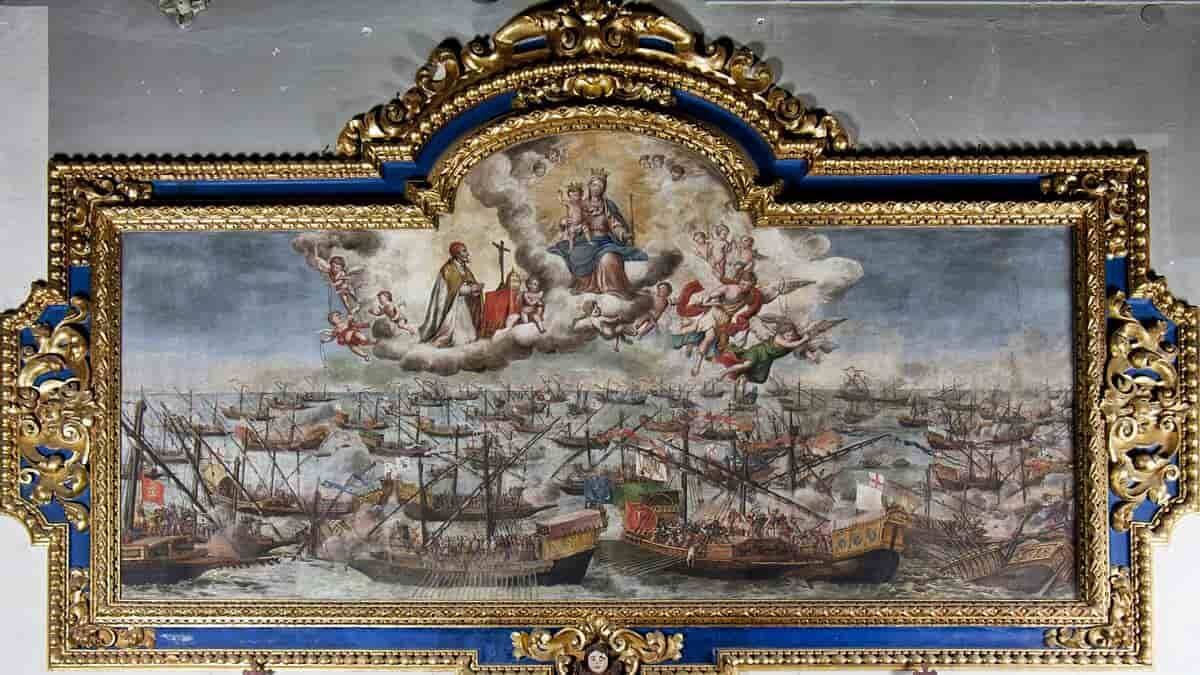
La Virgen del Rosario protegiendo las naves españolas en la Batalla de Lepanto. Lucas Valdés, ca. 1700.
“Humanity in every age, and even today, looks to works of art to shed light upon its path and its destiny.”
— Pope Saint John Paul II in his “Letter to Artists”
The teaching of art in the classroom can shed light on historical topics and stories while bringing them to life for students and inviting them to reflect on their own human nature. This is even more important in our current digital age where everything is an easy click away. Students taking time to sit in the quiet and reflect on a piece of art allows them to have a conversation across time. Presenting art in the classroom allows them to access deeply human experiences, and reveals our common narrative in a tangible way, helping history to come alive. For example, when one looks upon a great cathedral or stumbles across a fresco in a church, one encounters the stories and experiences of those who created it and allows our continued participation in them.
More than simply preserving history, art is part of humanity’s desire to imitate and create the world around us. As a result, when we study and observe these works, we begin to enter into a conversation with the artist and his time. We ask questions not only about the work itself but also about ourselves. Because every work is situated within a particular culture, art reflects the discussions of its time, including debates about politics, philosophy, and theology. It is both timeless and time-bound, serving as genuine evidence of the past which is gone but not forgotten. For this reason, in a world that is overrun with imitations and simulations, the study of authentic works of art can give us a real glimpse into the souls of men and women. The study of art not only brings us into this ongoing conversation but also invites us into a deeper internal engagement and development of our aesthetic sensibilities.
” Authentic culture and art preserve this spark, resisting the normalization of evil. For this reason, certain works have taken on an almost prophetic significance…” Pope Leo XIV (“Magnifica Humanitas,” Paragraph 122)
Art is then one of the means through which we can come once again to realize the magnificence of our own shared humanity in a world that so often seeks to rob us of it.