
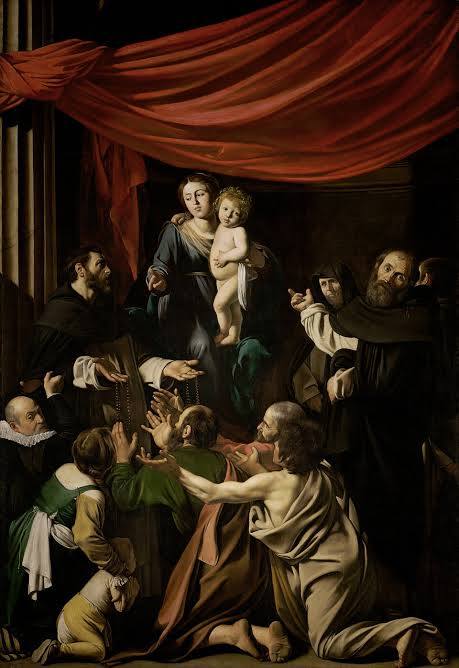
Madonna of the Rosary. Caravaggio, ca. 1607.
Every year, Mother Church celebrates the feast of Our Lady of the Rosary on October 7th and dedicates the entire month to encouraging her children to embrace this devotion. Many Catholic schools will gather to pray the Rosary as a community at least once in the weeks ahead. This is a worthy practice, but as any teacher supervising an all-school Rosary at 2:55pm on a Friday knows, it can often fall a little short of engaging our students’ full attention…
This year, I invite you to consider studying a beautiful story, poem, song, or painting about the Rosary with your class in order to form their imaginations and hearts more profoundly. This article gathers resources for leading lessons that will deepen your students’ understanding and experience of the Rosary, helping them to develop a love for this powerful prayer.
Texts
Lower School
For the youngest learners, simply memorizing the vocal prayers and mysteries is a great start. Once students have learned these, introduce them to the history of the Rosary with Shaun McAfee’s storybook St. Dominic and the Rosary. For upper elementary school students, Champions of the Rosary by Fr. Donald Calloway, MIC is a good source for short read-alouds or narrations about saints who were devoted to the Rosary.
Upper School
Our Lady of the Rosary was originally known under the title Our Lady of Victory. This liturgical commemoration was inspired by a critical naval battle which took place on October 7th, 1571 near the port of Lepanto. Led by John of Austria and supported by Pope Pius V’s exhortation to pray the Rosary, the Christian fleet won a decisive victory over their Ottoman counterparts. G.K. Chesterton’s poem “Lepanto” is a classic way to inspire students’ imaginations as they study this moment of history which illuminates Mary’s role as intercessor and instrument of God’s providence. Or, consider teaching this pair of poems that highlight the Rosary in the context of living out our individual vocations: “O Rosary that Recalled my Tear” (Aithbhreac Corcadail/trans.
Derick Thomson) and “Nuns of the Perpetual Adoration” (Ernest Dowson), which are both printed in 100 Great Catholic Poems.. There’s an almost infinite number of books that offer insight into the Rosary’s structure, purpose, and mysteries. Some personal favorites include St. John Paul II’s apostolic letter Rosarium Virginis Mariae, Romano Guardini’s The Rosary of Our Lady, and Fr. Ed Broom, OMV’s Total Consecration through the Mysteries of the Rosary. All three could be utilized as sources for instruction or offered to older students as spiritual reading for chapel visits throughout the month.
Music and Paintings
Lower School
Those who sing pray twice! “Sing of Mary” is a well-known hymn, but one verse with an explicit emphasis on the Rosary often isn’t printed in contemporary hymnals: “Joyful Mother, full of gladness, in your arms your Lord was born. Mournful Mother, full of sadness, all your heart with pain was torn. Glorious Mother, now rewarded with a crown at Jesus’ hand, age to age your name recorded shall be blest in every land.” Either just this verse or the entire hymn can be learned easily by younger children. For upper elementary, “O Queen of the Holy Rosary” features a fun tune and evocative lyrics that describe the lovely image of gathering a bouquet of roses for Mary by our prayer.
Upper School
Fr. Michael O’Connor, OP’s “Totus Tuus” is a joyful, reverent contemporary composition perfect for middle and high school singers, whether studied in a choir class or within homerooms and house systems. Heinrich Ignaz Franz von Biber’s virtuosic Mystery Sonatas also offer a rewarding avenue for attending to beauty communally. Each composition focuses on one mystery of the Rosary – invite your students to listen carefully together and discuss ways that the music might illustrate the events and themes of that moment in the lives of Mary and Jesus.
Finally, consider one of the following masterworks for picture study or visio divina at any age:
● Madonna of the Rosary (Caravaggio)
● The Virgin of the Rosary (Bartolome Esteban Murillo)
● The Virgin and Child with singing angels (Bernard van Orley)
● Allegory of the Battle of Lepanto (Paolo Veronese)
Mary, Queen of the Holy Rosary, pray for us and for our students!