
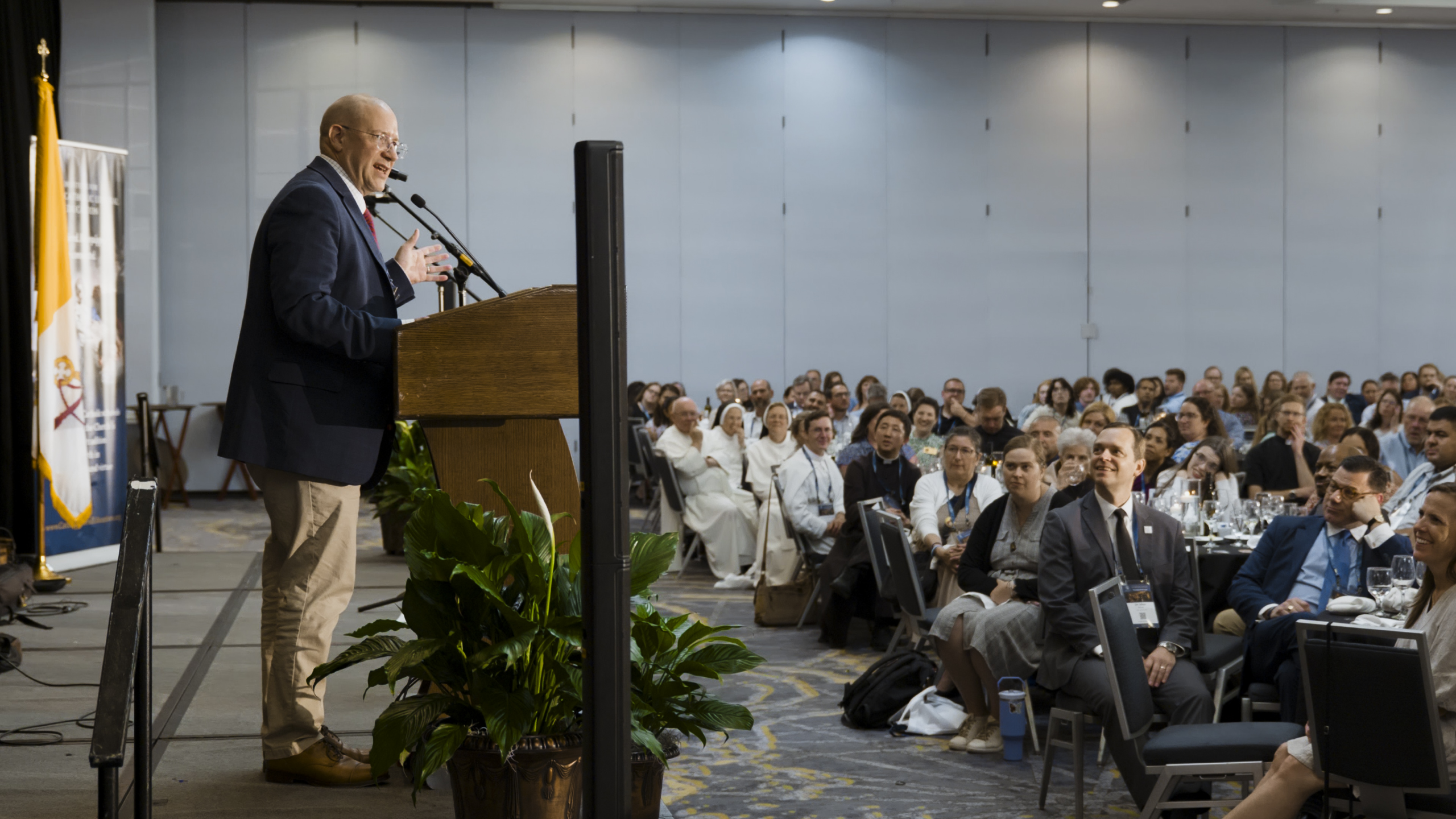
John M. Dejak, J.D., Director of the Secretariat of Catholic Education for the United States Conference of Catholic Bishops gave remarks at the July 16 Convivial Banquet during the 2026 ICLE National Conference.
“I think that if any good thing shall go forward, something must be adventured.”
—St. Thomas More, A Dialogue Concerning Heresies
Mary Pat Donoghue made fun of my midwestern road warrior ways in my choice to drive to this year’s ICLE Conference. Yet, in this 250th year of our nation’s birth, what better way to capture the American spirit than by taking to the open road, windows rolled down, wind blowing through my locks, and the freedom that comes with it! As has become my custom, these remarks were written a few hours ago—feverishly—in the hotel room. I submitted the title some time ago—I’m great at titles!—but when it comes to actually sitting down to compose the talk, it is a bit more challenging; all the more so when it is to be presented in the presence of such an august group of Catholic educators. One thing will be readily apparent: this was in no way written by AI. The inelegance of expression, the nervousness with which it is delivered, and the lack of precision are all mine. There was no prompt entered to produce in the listener sympathy for feigned humility. However, if there is anything good in it, it likely came from my bride, Annie, who is the nihil obstat and the “brains of the outfit.”
The roadtrip from Virginia to Columbus was a winding and interesting one. If I have the occasion and time is not an issue, I like to take the back roads and see the hidden and out of the way places. My bride will tell you that I tire her with my talk of wanting to do the quintessential American road trip down Route 66 (which also celebrates its 100th anniversary this year). I tire her even more with my furtive and unfulfilled preparations when I watch over and over homemade YouTube documentaries featuring the American kitsch and regional pride of this 20th century secular Camino. In a similar way, the trip to Columbus was no different—there is regional pride and not a little amount of kitsch. (As an aside, especially memorable for me was Zanesville, Ohio’s Rushing Wind Biker Church. A quick perusal of its Facebook page shows a simple no-nonsense evangelicalism that caters to Harley riders and ZZ Topp lookalikes…as well as their husbands! In all seriousness, it is an example of what naturally is at the heart of every human person: the desire to seek God. Something one witnesses across our country and throughout its history.) Toward the beginning of my trip I wound my way amidst the hills and hollers of West Virginia following the George Washington Heritage Trail through the small town of Paw Paw on one of the bends of the Potomac.
One can imagine Washington traversing this land in then-western Virginia and in his service in the French and Indian War. Traveling through the region zigzagging through Maryland, West Virginia, and Pennsylvania one also is put into contact with the earlier inhabitants of the area. Unpronounceable names ending in “–quehanna” or “-gheny” bring to one’s lips the languages of the peoples of these lush and verdant lands. Unlike other regions in the country, when one travels up and down the Eastern Seaboard, he can get the flavor of old England. Towns like Alexandria, Charleston, and Savannah all have architecture and particular local ways that originated in the Mother Country. Certain parts of rural western Virginia and even parts of West Virginia still have the aroma of the original English colonies. Again, one of those hidden things that I like to explore.
Something that was likely known among the citizens of those colonies was the patriotic British song “Rule Brittania.” The song was published in 1740 to celebrate the British Navy and the empire “on which the sun never set.” Its music was composed by Thomas Arne who also composed the song “A Hunting We Will Go”—a nursery rhyme which, perhaps, some of you might teach your young charges. Arne was baptized and raised a Roman Catholic and came from a prominent recusant family. The song is synonymous with the pride of the British people and the lyrics reflect something which Englishmen the world over held dear: their freedom. The poignant line of the refrain is “Britons never, never, never, never will be slaves.” Liberty finds itself deep within the soil of England and its traditions were forged through Roman, Anglo-Saxon, and Norman rule and influence. The Church came to the islands at the end of the Roman period, the cross was planted, and our Lord pitched his tent through intrepid missionaries and apostles. It was in these circumstances and in the light of faith that the customs, privileges, and liberties of the English people were forged. This was “Merrie England.” Catholic England. From the time of Augustine of Canterbury to Thomas More, roughly 1000 years, England and the unique liberties and freedoms enjoyed by her citizenry were the result of a “stew” that included the natural law, longstanding local customs, the common law and the Catholic Church.
This changed when Henry VIII arrogated to himself an authority that was not his, enriched his friends, and introduced—ironically—a certain form of totalitarianism into the British experience. Outward manifestations are indicative of hidden and inward realities. The decisions of a man in the quiet of his conscience can affect whole civilizations. Magna Carta was violated when Henry made his decision; the law was broken. The Church and the people were not free. Rule was the preserve of a self-appointed elite. The Arne Family, keeping first things first—knowing, loving and serving God in this world so that they could be happy with him forever in the next—suffered and paid dearly as Catholic recusants for their liberty.
However, in the designs of Providence and perhaps with not a little bit of cognitive and theological dissonance (though I will not judge our founders too harshly), the tradition of freedom lived on in the hearts and collective memory of the English people including the colonists who came to North America. These settlers may have channeled Thomas More—though he was “cancelled” by that time—when he said: “I think that if any good thing shall go forward, something must be adventured.” “Adventured” they did and at the time that “Rule Brittania” was published and popularly sung, the colonists proclaimed that strain ever more loudly and boldly to a King and Parliament increasingly dismissive of those liberties and the traditions of Englishmen.
250 years ago, in order to preserve those liberties, a break was made and the United States was born. It was founded ultimately in order to form a more perfect union, but it wasn’t a perfect union. Nothing on this earth is. A Civil War would be fought 90 years later over that very question. But one thing that the founders did know and understand (even amidst their disagreements), was that the republic they fashioned was to be for a moral and virtuous people. George Washington famously said, “Virtue or morality is a necessary spring of popular government.” Likewise, John Adams commented: “Our Constitution was made only for a moral and religious people. It is wholly inadequate to the government of any other.” Reflecting on this, the bishops of the United States in 1884 told the Catholic people:
Teach your children to take a special interest in the history of our own country. We consider the establishment of our country’s independence, the shaping of its liberties, and its laws as the work of a special Providence, its framers “building wiser than they knew,” the hand of the Almighty guiding them.
Outward manifestations are indicative of inward realities. The story of America’s founding and its government, culture, and laws being the child of Merrie England is indicative of the souls of the men and women who “adventured” to these shores in search of a good life. If the soul is in order, the culture and society will be in order. But we know from painful experience that the soul doesn’t just get into order; it must be cultivated and maintained in order. Perhaps we as Catholic educators hold the most important keys to the survival of our republic: providing a true education. A true education is a Catholic education—the means by which free men are formed. My great mentor, the late Professor Charles E. Rice of Notre Dame Law School, reminded his students countless times over his years teaching jurisprudence that, in the final analysis, governments and earthly powers will all pass away–but the human person will not. The human person has a dignity and a value that transcends the state.
The human person, made in the image and likeness of God, has an immortal soul and will live forever. Cultivating the garden of that soul is the gritty dirt-under-the-fingernails work that you do in your schools. Preparing the imagination of our children to be able to see as Christ sees, to act as he acts, and to love as he loves is your high calling. This is the promise and the prayer of the renewal—better, the recovery—of Catholic education. Those who keep first things first and understand who they are; from whom they come; where they are going; and why they are here are the ones who are truly free. This is the greatest thing we can do for our country: quaerere Deum, to seek God; to bring our children and our students to Christ, the Truth who sets us free.
[ John M. Dejak, J.D., Director of the Secretariat of Catholic Education for the United States Conference of Catholic Bishops initially gave these remarks on July 16, 2026 as the Banquet Address at the 2026 National Conference for the Institute for Catholic Liberal Education]